


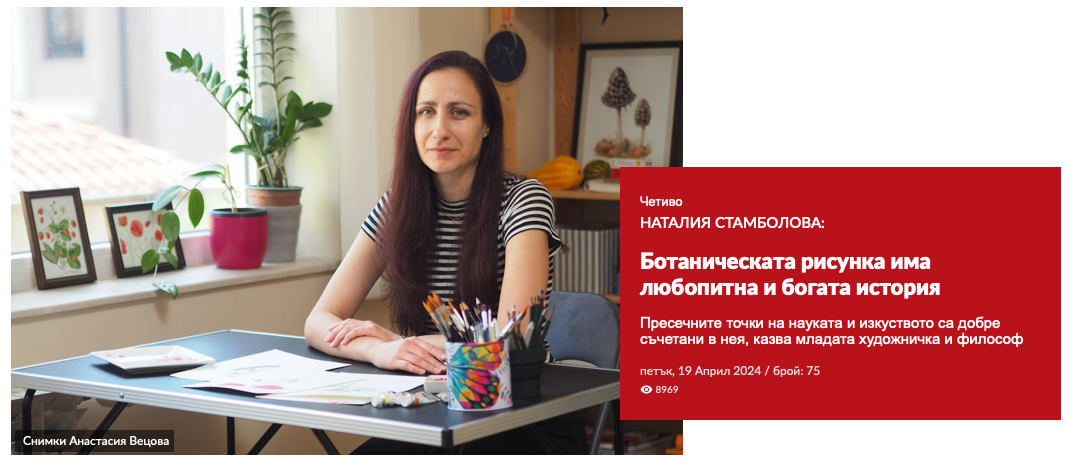
Nataliya Stambolova was born on January 28, 1985, in Sofia. She graduated from the 105th High School "Atanas Dalchev" with a profile in fine arts and Italian language. She studied philosophy at Sofia University "St. Kliment Ohridski," and in 2009, she received a master's degree in "Philosophy of Science." She works in the field of illustration, graphic design, and recently started developing web applications. She is a member of DAFNI - the Society of Animalists, Florists, and Scientific Illustrators, and in 2022, she began leading workshops on botanical illustration at the National Museum of Natural History, BAS.
- Nataliya, you will be leading a scientific illustration workshop dedicated to the Blue Scilla at the National Museum of Natural History on April 20 and 21. Does one need to have graduated from an art school to participate and draw in these workshops, which are a favorite part of the museum's popular program?
- I believe that one should not feel limited by whether they have prior experience or education, not only in drawing but in any topic that excites them, in order to get involved. The workshops I lead are aimed at both people with an interest in naturalistic illustration and artists who want to try a different technique or enrich their approach. The topics and materials are selected so that everyone can choose the method that suits them best. For beginners, I prepare an outline sketch to use as a base, and for advanced participants, I provide live plants from which they can create their own drawing. When we first started organizing these events together with DAFNI and the National Museum of Natural History, we weren't sure what kind of audience we would attract or if there would be any attendance at all. To my very pleasant surprise, it turned out that the workshops are attended by people with extremely diverse professional backgrounds and personal interests.
- Is it necessary to be a botanist to practice botanical illustration?
- No, it is not necessary. What is required is patience, observation skills, and an inclination towards detailed artistic work. History knows cases where botanical illustration has led to new scientific discoveries – a scientist notices something for the first time thanks to a drawing, as the artist paints with a fresh and unburdened eye. It also happens that artists, working primarily in nature, discover new plant species, which is stepping into the field of so-called citizen science – when amateurs help collect scientific data.
- How do you choose the topics for the workshops?
- When we started the classes at the museum in 2022, my initial goal was to select topics that are well-known and close to the public, and compositionally simpler. Therefore, the first plants we illustrated were garden pansies, autumn leaves, tulips, snowdrops, etc. Since last year, I began using more complex compositions, and this year my focus will be on wild plants found in Bulgaria. In February, we drew hellebores, this weekend there is a workshop on the Blue Scilla, and the next topic will be the common poppy.
- Is this just a pleasant activity where participants learn curious facts, or can they get a certificate to use for future professional realization?
- No, we do not issue certificates at the workshops. If we talk about utilitarian benefits, botanical illustration, like any type of drawing and art in general, does not have established and predefined trajectories for professional realization. Even in places like the UK or Australia, where the field of scientific illustration is highly developed, the professional path is not well-trodden. Pursuits intertwining art and science are always difficult and uncertain. Therefore, it is still too early to think about issuing a certificate, especially given the initial stage of development of this topic in our country. However, the process of creating such an illustration offers much more than the finished image on paper. If you spend just 10 minutes drawing a plant, you will learn much more about it than if you observe or photograph it, even for an hour. It is a time when something seemingly as mundane as a tree leaf turns into a boundless universe to study. By observing nature more carefully, we begin to understand it better. And once you begin to understand something, it becomes much harder to remain indifferent to it.
- Tell us more about what botanical illustration is.
- Botanical drawing has a very curious and rich history dating back to the Age of Discovery. Artists took part in distant and dangerous voyages, during which they documented the newly discovered flora and fauna with drawings. Initially, these drawings had only a scientific purpose – precise reproduction for the purpose of identification. The interest in new plant species brought from distant journeys led to the emergence and maintenance of private gardens with them, and this was considered a sign of good taste. Books with botanical drawings, or so-called 'florilegia', began to be produced and eventually collected. This is where my social media pseudonym comes from – Natal Florilegia. Thus, botanical drawing crossed beyond the realm of purely scientific illustration and established itself as a distinct artistic style. We, for obvious reasons, do not have deep roots and traditions in this type of art, but I hope we will gradually begin to develop them.
- Most of us probably do not realize how much reading, research, knowledge, connection with nature, and exceptional observational skills an artist must possess to recreate a plant, insect, or animal so precisely and accurately.
- It seems to me that this applies to almost all pursuits – until one delves into a certain field, there is no way to guess what lies at its foundation. We usually see only the final result, while the process and the roots remain hidden. Interestingly, the illustration of new flora and fauna species and the use of drawings in publishing manuals have not been displaced by photography. This is because, in illustration, we are not bound to a specific specimen, which in some sense is random. We have the ability to isolate and highlight what is important and leave aside what is not, thus conveying the archetypal idea of a given plant (animal or insect).
- Images of flowers are always exquisite. But when I saw your original cards and paintings for the first time years ago, I realized how perfectly a red pepper, an eggplant, a kohlrabi, and even a few cloves of garlic can look – like a work of art.
- When I look at botanical drawings, Dutch still lifes, and generally works by the Old Masters, I am always overcome with a sense of awe. Everyday objects become mysterious and hold hidden messages, and a simple bouquet in a vase or a bowl of fruit is a lavish, almost ecstatic experience. Creating such works has always seemed unattainable to me, almost like a lost art. Now I am very happy that through my work in botanical drawing, I am getting even a little closer to this aesthetic.
- What is the difference between a still life, a landscape, and a botanical drawing?
- I think one of the most important differences – aside from the lack of a background – is that in a botanical drawing, everything is in focus. In traditional painting, we have levels of detail and usually one focal point. A botanical drawing can also have a compositional center, but the approach to details is different. They are all meticulously developed, and the drawing process is almost graphic – with phased layering and working on small sections. The finished result takes a long time, and the four hours in which I conduct the classes serve more as an introduction to this technique. In contrast, watercolor usually implies fast and intuitive work, and finishing the image is done almost "in one breath," also known as "alla prima" painting. Curiously, in school, I much preferred graphics, and the traditional style of watercolor painting did not come naturally to me at all. I often ended up with a "muddy" drawing – when an unsuccessful attempt at "wet on wet" led to several colors mixing into brown. Now it seems almost ironic that watercolor is my preferred medium, which I want to study and use more and more.
- You participate in plein-air events, exhibitions, competitions, and win awards. It seems you are constantly seeking to build upon your knowledge and skills. Is that why you do it?
- Yes, when a topic interests me, I have a tendency to dive deep and constantly look for new sources of knowledge. And participating in such events is somewhat a secondary effect of my interest and active engagement with this niche genre. However, my desire is also connected to sharing and introducing more people to this highly curious and specific style of drawing. This is something I believe suffers in our country – we lack sufficiently active creative communities; everyone works independently, and the prevailing opinion is that the craft is "stolen." Technique does not make the artist, but sharing different approaches and being in an environment of people with similar interests helps everyone develop what only they can convey through their individual perspective. When I purposefully started researching and looking for sources in this field a while ago, everything I found was in English or Russian. Now, with the help of DAFNI and the National Museum of Natural History, BAS, I hope this will gradually change, and besides the workshops, we will continue developing this field in Bulgarian as well.
- You studied philosophy. What do philosophy and scientific illustration, to which you have devoted much of your attention and work, have in common?
- As became evident from my previous answers, I tend to delve deeply into specific topics, and what better discipline for this than philosophy, and later on, scientific illustration. The intersection of science and art, which has always excited me, is so well combined in botanical drawing. And philosophy, of course, is wonderful and perhaps even the best foundation for development in any other field, provided one has the right mindset for this type of education. I am also very happy to have the opportunity to work collaboratively precisely with the National Museum of Natural History, where my mother, a scientist dealing with inorganic chemistry, used to take me as a child, and where everything caught my eye and curiosity. However, I believe we should distance ourselves from the expectation that all our interests must be "justified" through formal education. There certainly exist invisible threads that guide us in one way or another in a specific direction, but we must dare to follow them without necessarily asking where they come from or where they will lead us.
- The Society of Animalists, Florists, and Scientific Illustrators, of which you are a member, is a community of people with shared interests. What are the causes the association and its members stand behind?
- The first DAFNI exhibition I took part in, back in 2020, was related to an international conference on conservation-significant species. I chose to depict two aquatic plants – the white water lily (Nymphaea alba) and the fringed water lily (Nymphoides peltata), both included in the "Red Data Book." I selected these two plants because of the opportunity to observe them in their natural habitat in the Dragoman Marsh, which is located just about 40 km from Sofia. Even though it was almost entirely dried up, the leaves of the fringed water lily were visible right at the beginning, and further in, I also found the white water lilies. It was a real adventure trying to reach them over a wooden boardwalk that had been destroyed in many places by a major fire. Unfortunately, this fire also destroyed a significant part of the marsh vegetation, and the deepening problem with water resources, drought, and fires is very visible there. Through the exhibitions organized by DAFNI, we undoubtedly contribute to directing public interest towards ecology, biodiversity, and generally towards nature conservation topics. And what better way to present these topics than by illustrating them with scientific drawings.